# Custom SimObject

You can add any SimObject that you have installed to the world. You can give the SimObject a constant speed. Routes are not supported yet.

{% hint style="warning" %}
Other players may not have the same SimObjects installed as you. If you share the mission, the custom SimObjects may not show up for them.
{% endhint %}

### Attributes

<table data-header-hidden data-full-width="false"><thead><tr><th width="109.99993896484375">Attribute</th><th>Description</th></tr></thead><tbody><tr><td><strong>Active On Start</strong></td><td><strong>Enabled:</strong> the SimObject will be visible as soon as the missions starts<br><strong>Disabled:</strong> you need to activate the SimObject during the mission</td></tr><tr><td><strong>SimObject Title</strong></td><td>Title of the Sim Object. See <a data-mention href="#how-to-find-the-simobject-title">#how-to-find-the-simobject-title</a></td></tr><tr><td><strong>Is Aircraft</strong></td><td>Is the SimObject an aircraft?</td></tr><tr><td><strong>Orientation</strong></td><td>Heading of the SimObject in true degrees north (not equal to magnetic north)</td></tr><tr><td><strong>Altitude</strong></td><td>Altitude above sea level in feet</td></tr><tr><td><strong>On Ground</strong></td><td>Ignore the altitude and spawn on ground</td></tr><tr><td><strong>Speed</strong></td><td>Speed of the SimObject in knots</td></tr><tr><td><strong>Simobject Spawn Radius</strong></td><td>Radius (meters) in which the SimObject is randomly spawned. (0 = exact location)</td></tr></tbody></table>

### Actions

<table data-header-hidden><thead><tr><th width="110">Action</th><th>Description</th></tr></thead><tbody><tr><td><strong>Activate</strong></td><td>Spawn the SimObject in the world</td></tr><tr><td><strong>Deactivate</strong></td><td>Remove the SimObject</td></tr></tbody></table>

### Events

**Custom SimObject** doesn't have any events.

## How to find the SimObject title

{% tabs %}
{% tab title="MSFS2024" %}

### 1. Enable Devmode

Under *General* settings, in the tab *Advanced Options*, enable *Developer Mode*.

<div align="left"><figure><img src="https://3284314497-files.gitbook.io/~/files/v0/b/gitbook-x-prod.appspot.com/o/spaces%2FQEwJpcf1IkEF6flfrOBX%2Fuploads%2FehTqls8O3i2TAGTvwPfn%2Fimage.png?alt=media&#x26;token=a941cb87-d069-4a7b-a3d9-f7c5f4b21ab3" alt="" width="563"><figcaption></figcaption></figure></div>

### 2. Open the SimObject Spawner tool

<div align="left"><figure><img src="https://3284314497-files.gitbook.io/~/files/v0/b/gitbook-x-prod.appspot.com/o/spaces%2FQEwJpcf1IkEF6flfrOBX%2Fuploads%2F2R0Yoh2sNVJiHmKxDFda%2Fimage.png?alt=media&#x26;token=929e7082-c977-4eef-8e20-8a8fc250fccb" alt="" width="563"><figcaption></figcaption></figure></div>

You can search through all SimObjects, and filter per package.

<div align="left"><figure><img src="https://3284314497-files.gitbook.io/~/files/v0/b/gitbook-x-prod.appspot.com/o/spaces%2FQEwJpcf1IkEF6flfrOBX%2Fuploads%2Fqd2CV78lGkJZKOnH1rJs%2FSimObject%20Spawner.jpg?alt=media&#x26;token=704b0793-8208-40de-91e7-f2935ec4284a" alt="" width="563"><figcaption></figcaption></figure></div>

### 3. Copy the SimObject Title without brackets

The selection dropdown gives you the SimObject title you need to enter in the Mission Hub. You should not add the part inside the brackets, as that is the livery name and not part of the SimObject title.

{% hint style="warning" %}
You need to type the title exactly, without the part between brackets, to have it successfully spawn in your mission.
{% endhint %}
{% endtab %}

{% tab title="MSFS2020" %}

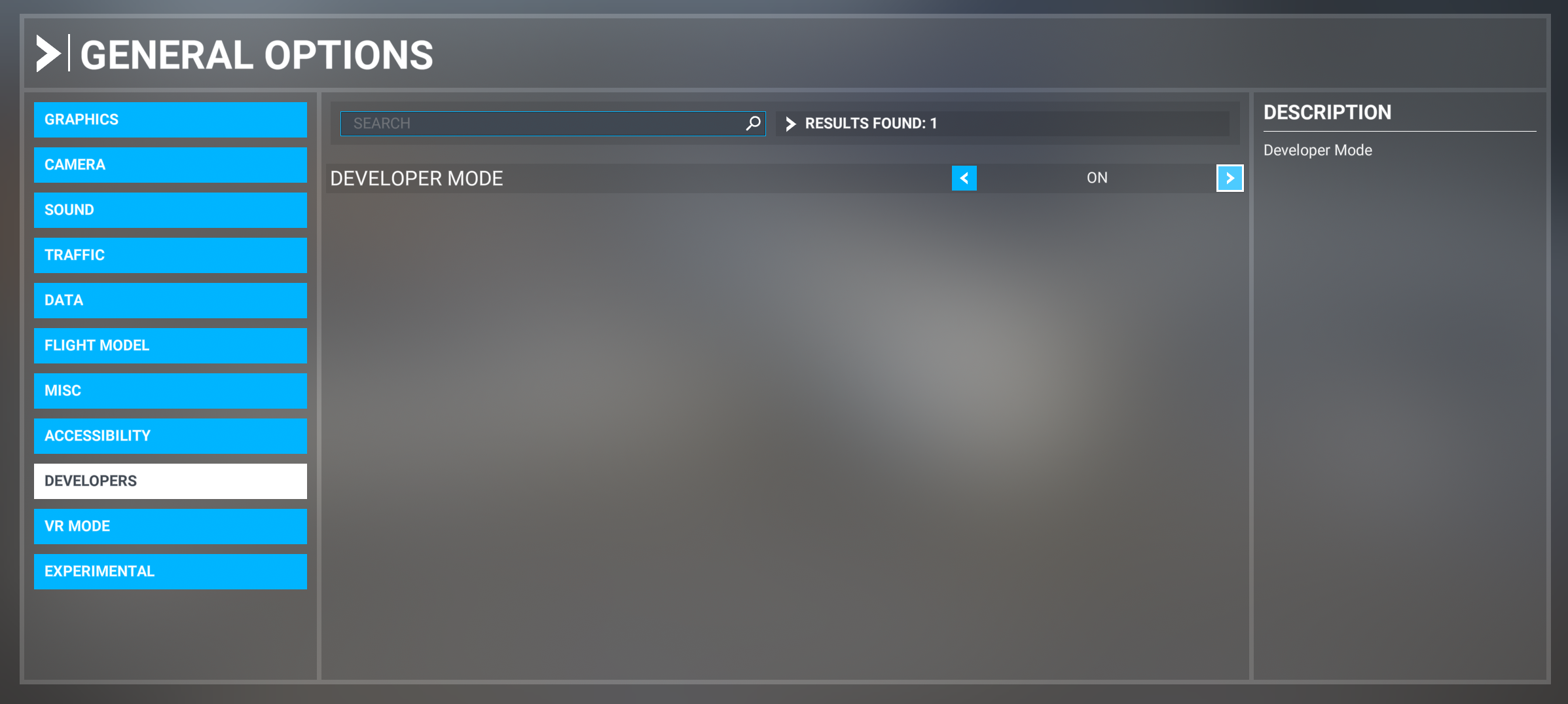
### 1. Enable Devmode

<div align="left"><figure><img src="https://3284314497-files.gitbook.io/~/files/v0/b/gitbook-x-prod.appspot.com/o/spaces%2FQEwJpcf1IkEF6flfrOBX%2Fuploads%2Fp8veGzhchaJZHQwaAxwf%2Fimage.png?alt=media&#x26;token=10a86039-b8d6-4964-aa30-e8086b69b358" alt="" width="375"><figcaption></figcaption></figure></div>

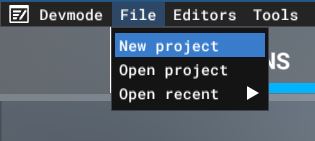
### 2. Create a new project

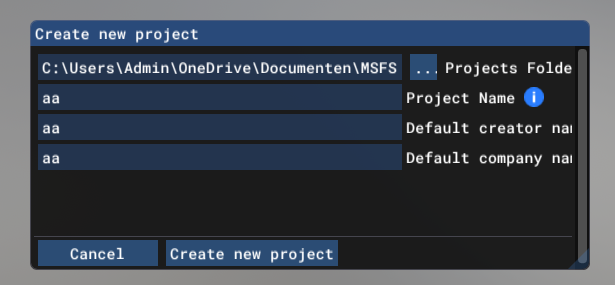
<div align="left"><figure><img src="https://3284314497-files.gitbook.io/~/files/v0/b/gitbook-x-prod.appspot.com/o/spaces%2FQEwJpcf1IkEF6flfrOBX%2Fuploads%2Ff12xY0aaQf0YrXGaSUNP%2Fimage.png?alt=media&#x26;token=5c82dc8b-f13c-45cf-9e37-4d667f6e7f45" alt=""><figcaption></figcaption></figure></div>

It doesn't matter what you fill in here. Click create new project.

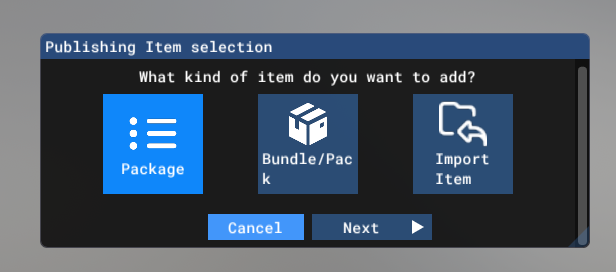
<div align="left"><figure><img src="https://3284314497-files.gitbook.io/~/files/v0/b/gitbook-x-prod.appspot.com/o/spaces%2FQEwJpcf1IkEF6flfrOBX%2Fuploads%2FXXqtgGq9kmQDFj3Bhhez%2Fimage.png?alt=media&#x26;token=b75d585f-59ff-43aa-b4e3-9fc6a3c259e3" alt="" width="461"><figcaption></figcaption></figure></div>

On the next screen, click Cancel

<div align="left"><figure><img src="https://3284314497-files.gitbook.io/~/files/v0/b/gitbook-x-prod.appspot.com/o/spaces%2FQEwJpcf1IkEF6flfrOBX%2Fuploads%2FWHgk5iGx60jba6Vfvf4x%2Fimage.png?alt=media&#x26;token=1023f99f-7ebb-467d-9a90-8c3a2046da5a" alt="" width="308"><figcaption></figcaption></figure></div>

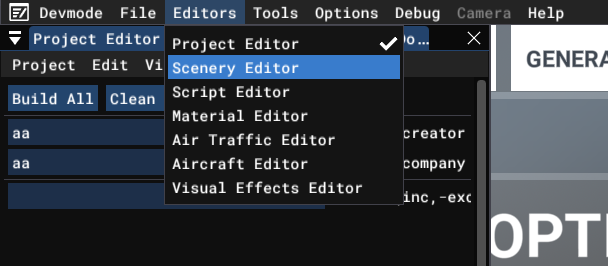
### 3. Open the scenery editor

<div align="left"><figure><img src="https://3284314497-files.gitbook.io/~/files/v0/b/gitbook-x-prod.appspot.com/o/spaces%2FQEwJpcf1IkEF6flfrOBX%2Fuploads%2FXv0gymvJV0XRsYk5EuVD%2Fimage.png?alt=media&#x26;token=eb43a145-5caf-4d07-929b-fd8b91eeda40" alt="" width="456"><figcaption></figcaption></figure></div>

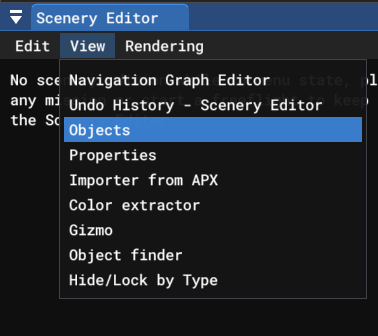
### 4. Use the Objects panel

In the scenery editor, click the View dropdown, and enable the Objects panel.

<div align="left"><figure><img src="https://3284314497-files.gitbook.io/~/files/v0/b/gitbook-x-prod.appspot.com/o/spaces%2FQEwJpcf1IkEF6flfrOBX%2Fuploads%2FlgzpZKgFAzYdNvEqI7aU%2Fimage.png?alt=media&#x26;token=1c30f255-7272-4a06-bbb0-d52635ff8435" alt="" width="284"><figcaption></figcaption></figure></div>

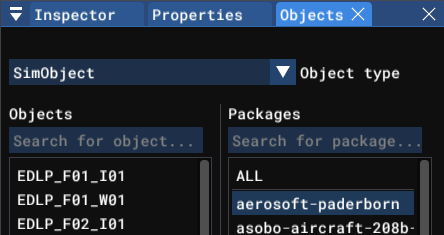
Now the *Objects* panel should be visible. In the *Object type* dropdown, select *SimObject*.

<div align="left"><figure><img src="https://3284314497-files.gitbook.io/~/files/v0/b/gitbook-x-prod.appspot.com/o/spaces%2FQEwJpcf1IkEF6flfrOBX%2Fuploads%2Fb9lIecb98eEoKtmk4srS%2Fimage.png?alt=media&#x26;token=735e578b-8a31-4a66-bdba-7e0e2259a42a" alt=""><figcaption></figcaption></figure></div>

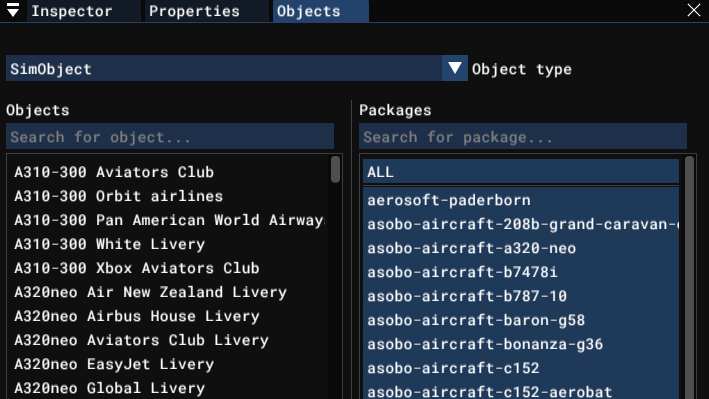
On the right side of the panel, you see the Packages.

You can select ALL, to see all installed SimObjects, or select the package that contains the SimObject you want to use.

On the left side of the panel, you see a list of all SimObject titles.

<figure><img src="https://3284314497-files.gitbook.io/~/files/v0/b/gitbook-x-prod.appspot.com/o/spaces%2FQEwJpcf1IkEF6flfrOBX%2Fuploads%2F8eg293sGJ1tgneDF6cRx%2Fimage.png?alt=media&#x26;token=c21b8444-a1f8-47b6-a33b-e6853ae50751" alt=""><figcaption></figcaption></figure>

### 5. Copy the SimObject Title

From the left side of the Objects panel, choose the SimObject you want to use. You need to type that title exactly in the Mission Hub in order to have it successfully spawn in your mission.
{% endtab %}
{% endtabs %}

## See also

* [#world](https://docs.miltechsimulations.com/miltech-mission-hub/detailed-documentation/map-objects#world "mention")


---

# Agent Instructions: Querying This Documentation

If you need additional information that is not directly available in this page, you can query the documentation dynamically by asking a question.

Perform an HTTP GET request on the current page URL with the `ask` query parameter:

```
GET https://docs.miltechsimulations.com/miltech-mission-hub/developer-sdk/advanced-map-objects/custom-simobject.md?ask=<question>
```

The question should be specific, self-contained, and written in natural language.
The response will contain a direct answer to the question and relevant excerpts and sources from the documentation.

Use this mechanism when the answer is not explicitly present in the current page, you need clarification or additional context, or you want to retrieve related documentation sections.