 DOCUMENTATION
Angle of Attack (AOA)
The U-2 is landed by angle of attack, not by airspeed. Our rendition of the U-2S gives you three AOA cues: a gauge on the PFD, a three-light indexer on the glare shield, and audio tones in your headset.
Sim values. Performance values are measured in the sim. They may not accurately represent (nor do they intend to accurately represent) the performance of the real aircraft.
What the Number Means
The aircraft does not show AOA in degrees. It shows normalized AOA: how much of the wing's available lift you are currently using. .50 means half, 1.00 means the wing is stalled. Because flaps and spoilers change how much lift is available, the number already accounts for them - .70 is the right approach AOA whatever your weight or configuration.
PFD AOA Gauge
A vertical tape beside the attitude display, numbered 1 to 9 (= .10 to .90), with a digital readout such as .70.
- White wide tick at .45 - best range.
- White triangle at .60 - maximum endurance.
- A color strip appears once AOA rises above .50: yellow .55 - .65, green .65 - .80, red above .80. The indexer lamps follow these bands.
Standby AOA Gauge
A round AOA gauge at the lower left of the main panel repeats the normalized AOA with a needle. It works whenever the AOA system has power, gear up or down.
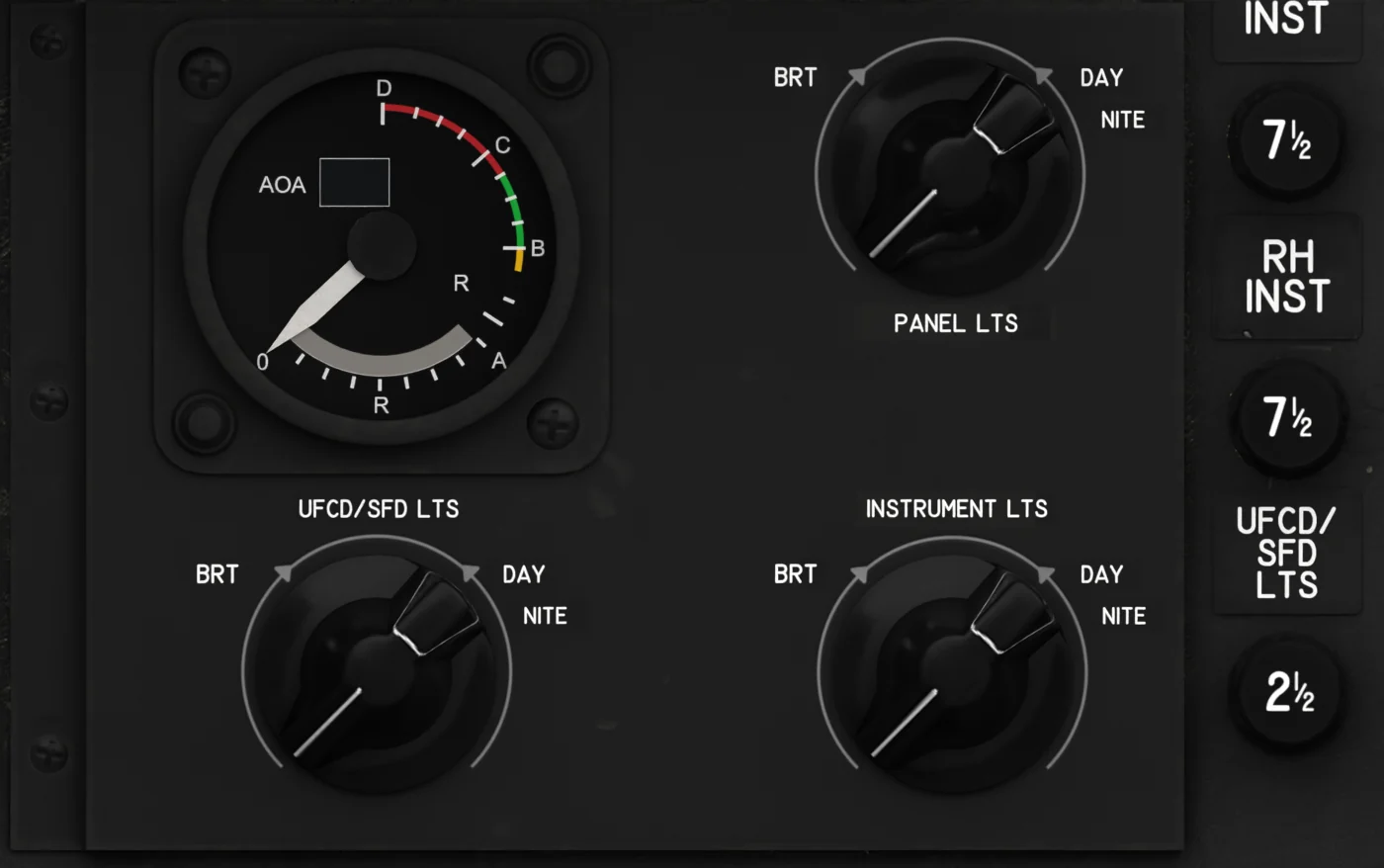
- PANEL LIGHTS - Dims the panel and switch legend lighting and the console glow. Fully anticlockwise is off; runs on essential AC, so it goes out when both AC generators are lost.
- STANDBY AOA - Repeats the normalized AOA with a needle, independent of the PFD. Works whenever the AOA system has power, gear up or down.
- UFCD/SFD LIGHTS - Brightness of the UFCD and SFD displays.
- INSTRUMENTS LIGHTS - Dims the instrument lighting: standby engine and AOA gauges, oxygen gauges, gear indicators. Fully anticlockwise is off; runs on emergency AC, so the emergency inverter keeps it after the generators are lost (EMER INV in NORM).
Spotlights. One on each side console. Scroll on the lamp to turn its knob: off, then 10 to 100 % in 10 % steps. Hold a click on it for full brightness while you hold it (the full-bright button), whatever the knob says. They run on the essential DC bus: in a flameout they and the instrument lights are what is left.
Glare-Shield Indexer
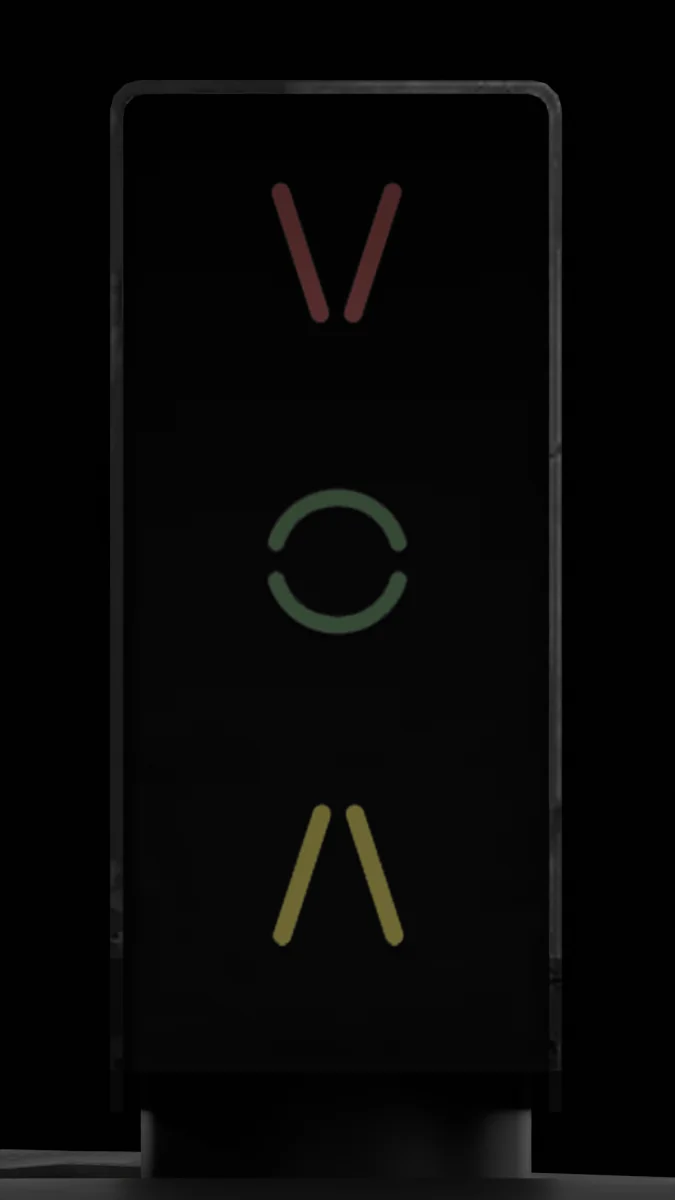
Three symbols stacked vertically, exactly where you look during the flare.
| Normalized AOA | Lit symbols | You are... | Do this |
|---|---|---|---|
| below .55 | - (dark) | well above approach speed | - |
| .55 - .62 | ▲ yellow | fast | Slow down / raise the nose |
| .62 - .65 | ▲ yellow + ● green | slightly fast | Small correction |
| .65 - .77 | ● green | on speed | Hold it |
| .77 - .80 | ● green + ▼ red | slightly slow | Small correction |
| above .80 | ▼ red | slow | Lower the nose / add power |
Gear up or down
The indexer follows the AOA whatever the landing gear position. It is dark below .55 AOA, so at high speed seeing nothing is normal. On the ground the AOA reads about .65 at the two-point attitude, so the green donut, or yellow and green, is normally lit on the ramp. It needs DC power (essential or monitored DC); MASTER LIGHT TEST lights all three symbols.
AOA Tones
As you slow through the approach and into the flare, the tone in your headset changes. This lets you keep your eyes outside during the landing.
| Normalized AOA | Tone | Sound |
|---|---|---|
| .70 - .80 | Approach | Low (300 Hz) beeps, 1 per second speeding up to 3 per second |
| .80 - .90 | Flare | Steady mid (500 Hz) tone |
| .90 - .98 | Touchdown | Higher (700 Hz) beeps, 3 per second speeding up to 6 per second |
| above .98 | Stall | High (1450 Hz) tone |
- Tones work with the gear up or down.
- At landing speeds the AOA scale goes with the aircraft's weight, so the tones come at the right speeds for your weight. With flaps 35 at 1 g, T-speed reads about .80 where the steady flare tone starts, the touchdown beeps start about 4 kt below T and the stall tone about 7 kt below T, just before touchdown. The wing itself stalls under a knot later.
- Close to the runway the gauge reads the same way, by speed. The ground effect lets the wing fly several knots below the stall tone, so in the flare you will often hold her off in the stall tone before she settles.
- High up the gauge reads low in the cruise (it corrects for Mach), but close to the stall it follows the angle of attack: the chevron and the tones come before the stall as they do low down, and above 45,000 ft any tone is a stall warning - see High-Altitude Handling.
- They are muted on the ground. They become active 3 seconds after lift-off and stop 3 seconds after touchdown.
- During a long steady tone you may hear a very short gap roughly every 18 seconds. That is normal.
The AOA knob on the left-console volume panel silences the approach tones at its stop; the stall tone stays. If you hear no tones at all, check that knob and MASTER VOL, then run the self-test below.
Power
The AOA system works whenever the aircraft has normal DC power (either of its two supplies is enough). Without electrical power the indexer is dark and the tones are silent.
Self-Test (on the Ground)
- Make sure the aircraft has electrical power.
- Press and hold the MASTER LIGHT TEST button for more than 3 seconds.All three indexer symbols light as soon as you press.
- Keep holding: six tones play one after the other - two approach tones, the flare tone, two touchdown tones and the stall tone - 1.5 seconds each, repeating until you let go.
Stall Strips
With the EFB option Cockpit handle on Parking brake (the default) the wing's stall strips move by themselves: out at 24° of flap or more, in below 20°. On Stall strip they follow the handle right of the main panel and nothing else: pull it for out, push it for in.
They do not change the stall speed. With both out the wings stall alike; with them in a wing may drop at the stall, more with the flaps out, when heavy or slipping (Stall Recovery). If only one comes out, its wing stalls first and drops: on the Stall strip option push the handle in so both are in.
STALL STRIP IN / STALL STRIP OUT advise when the strips do not match the gear handle position (gear down with strips in, or gear up with strips out above 18,000 ft).