 DOCUMENTATION
Fuel System
The U-2 fuel system is designed to feed the engine from a single small sump tank in the fuselage, which is kept full automatically from the wing tanks. The system consists of four wing tanks, one sump tank, two boost pumps, sump and cross-transfer pumps, a fuel dump system and all associated indicators.
Sim values. Performance values are measured in the sim. They may not accurately represent (nor do they intend to accurately represent) the performance of the real aircraft.
Most of the time the system looks after itself. Your job is to watch the sump and keep the wings balanced.
The Tanks
| Tank | Name in the MSFS fuel menu | Capacity |
|---|---|---|
| Left inboard (wing) | LeftTank | 1,170 gal |
| Right inboard (wing) | RightTank | 1,170 gal |
| Left outboard (wing) | LeftAUXTank | 239 gal |
| Right outboard (wing) | RightAUXTank | 239 gal |
| Sump (fuselage) - feeds the engine | CenterSUMPTank | 99 gal |
| Total | 2,917 gal ≈ 19,500 lb |
The aircraft displays work in gallons; one gallon weighs about 6.7 lb.
How Fuel Feeds - Automatically
Float valves in the sump do the work. They need no electrical power and no action from you.
- The engine burns fuel from the sump.
- While the inboard tanks have fuel, they keep the sump topped up to 70 gallons, drawing equally from left and right - unless she slips: in a sideslip the wing on the ball's side feeds less and slowly gets heavy. Centre the yaw first, then balance with the cross transfer.
- When the inboards are empty, the outboard tanks take over and keep the sump at 50 gallons.
- If the sump ever sags below 48 gallons while the inboards still have fuel, the outboards join in to help.
- The feed is pushed by engine bleed air, which pressurizes the wing tanks. With the engine stopped they feed by gravity alone: about 1.2 gal/min in level flight, more in a climb and nothing in a descent of 1,000 ft/min or more. After a flameout only the SUMP TANK transfer pumps add to that, while they still have essential AC.
Watch the sump in the climb
At full power low down, the engine can burn fuel faster than the automatic feed (about 20 gal/min) can replace it, so the sump level sags. On top of that, the sump gauge reads up to 12 gallons low with the nose up (and up to 5 high with the nose down).
Together these can produce a FUEL SUMP LOW caution in a steep climb. Switch the SUMP TANK transfer ON, or lower the nose a little, and it recovers.
Empty sump = flameout
The engine only ever drinks from the sump. If the sump runs dry, the engine stops, no matter how much fuel is in the wings.
Fuel Panel
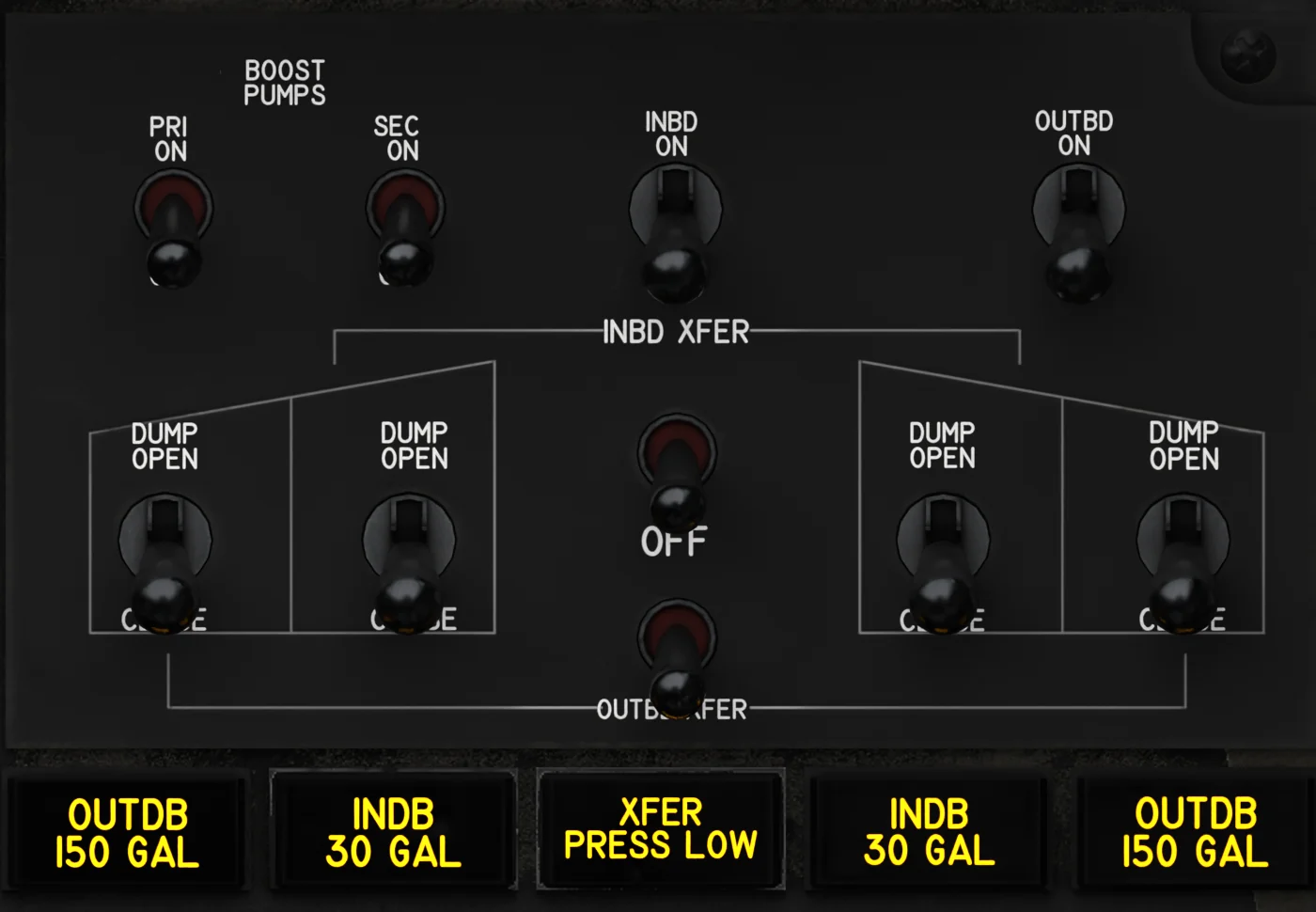
- FUEL BOOST PUMP PRIMARY - PRI ON / OFF. Primary boost pump, fuel pressure to the engine; both pumps ON for flight. One off gives BOOST PRESS LOW.
- FUEL BOOST PUMP SECONDARY - SEC ON / OFF. Secondary boost pump; ON with PRI for all normal flight. The engine keeps running on one pump.
- INBD SUMP TANK - ON / OFF. Pumps extra fuel from both inboard tanks into the sump, 14 gal/min, while the sump is below 70 gal.
- OUTBD SUMP TANK - ON / OFF. Pumps extra fuel from both outboard tanks into the sump while the sump is below 50 gal.
- INBD XFER - TO LEFT / OFF / TO RIGHT. Cross-transfers fuel between the inboard tanks, 7 gal/min, toward the light wing. Blocked while INBD SUMP TANK is ON.
- LEFT OUTBD DUMP - DUMP OPEN / CLOSED. Dumps the left outboard tank down to 150 gal (OUTBD 150 lamp, DUMP COMP). Close it afterwards.
- LEFT INBD DUMP - DUMP OPEN / CLOSED. Dumps the left inboard tank overboard; DUMP COMP at 30 gal, but it dumps to empty - close it yourself.
- RIGHT INBD DUMP - DUMP OPEN / CLOSED. Dumps the right inboard tank overboard; DUMP COMP at 30 gal, but it dumps to empty - close it yourself.
- RIGHT OUTBD DUMP - DUMP OPEN / CLOSED. Dumps the right outboard tank down to 150 gal (OUTBD 150 lamp, DUMP COMP). Close it afterwards.
- OUTBD XFER - TO LEFT / OFF / TO RIGHT. Cross-transfers fuel between the outboard tanks, 7 gal/min, toward the light wing. Blocked while OUTBD SUMP TANK is ON.
The XFER switches step OFF → TO RIGHT → TO LEFT → OFF with each click. ENGINE FUEL SHUTOFF (under a red guard, ON / FUEL OFF) cuts fuel to the engine: open the guard first; the valve takes about 5 seconds and needs emergency DC power. Closing the guard returns the switch to ON.
If your flight starts with the engine running, both boost pumps are already ON. From cold and dark they are OFF - switch them on before engine start.
Loading Fuel
Use the standard MSFS Fuel & Payload window. The aircraft reads whatever you set there.
- Always give the sump (CenterSUMPTank) at least 70 gal. If it starts empty the engine has nothing to drink until the automatic feed catches up.
- Fill the inboards (LeftTank / RightTank) next, outboards last, and keep left and right equal.
Monitoring Fuel on the MFD
Open SYS → PERF. You get three tapes and three computed numbers:
| Item | Meaning | Normal |
|---|---|---|
| FUEL pressure | Boost pump pressure, psi | 15-19 with both pumps, 11-15 on one pump. Yellow below 8. |
| SUMP | Sump quantity, gal | About 70 (50 when on outboards). Red at 38 or less. |
| TOTAL | The fuel counter, gal: counted down from the fuel flow, set with LOAD or 500 | Turns yellow / red below your bugs. It counts the burn at the fuel's temperature, so on a long cold flight it reads high - about 60 gal at the 50-gallon sump step from a 15 °C ramp, more from a hot one: set 500 there. CHECK TOTAL FUEL uses it. |
| FF | Fuel flow, gal per hour | |
| FOB | Endurance (h:mm) at the present fuel flow | Both swing with the throttle - read them in stable cruise. |
| RNG | Range at the present fuel flow and ground speed |
Setting Your Fuel Bugs
Bugs are your personal reminders. There are three: a sump bug, a yellow total bug and a red total bug. They start switched off on every flight, and the aircraft has no built-in "low total fuel" warning - so set them.
- On SYS/PERF press L4 EDIT. Each press moves to the next item: sump bug → yellow bug → red bug → LOAD.
- Change the value with the increase / decrease keys, or type it on the UFCD keypad. Shortcut: L5 / L6 set the sump bug to 35 or 65.
- L3 EXIT when done.
Falling below a bug gives you CHECK SUMP QTY or CHECK TOTAL FUEL (the red bug raises it to a warning).
SYS → CNSUM plots your fuel against a planned burn curve over the flight, together with liquid oxygen and oil.
Balancing the Wings (Cross-Transfer)
A fuel load from the simulator's fuel menu is evened out across each pair of wing tanks once it has settled, and the automatic feed draws equally from both sides in balanced flight. The wings go out of balance in a sideslip (the wing on the ball's side feeds less), or if you dump or cross-transfer unevenly.
To fix it, set the XFER switch towards the light wing and watch the wing come up. Transfer is slow - about 47 lb per minute.
- FUEL XFER ON shows while any transfer switch is on, and FUEL XFER 2 MINUTES reminds you every two minutes to check the balance.
- XFER PRESS LOW on a cross-transfer means nothing is flowing - the source tank is empty. Switch off. During a SUMP TANK transfer it also shows while the sump is still below its shut-off level, which is normal; it goes out as the sump fills, unless the source tank is empty.
- Cross-transfer is blocked while the SUMP TANK switch for the same pair of tanks is on.
Dumping Fuel
- Open the dump switch for each tank you want to dump. Dumping starts immediately. L INBD DUMP OPEN etc. show on the MFD.
- Watch for DUMP COMP (complete): inboards at 30 gal, outboards at 150 gal.
- Close the switches yourself - they do not close automatically, and an inboard tank will dump to zero.
| Tank | Rate (each side) | Stops at | Time from full |
|---|---|---|---|
| Inboard | 37.5 gal/min | empty | ≈ 31 min |
| Outboard | 30 gal/min | 150 gal | ≈ 3 min |
The sump keeps feeding the engine normally during a dump. After dumping everything you are left with about 370 gallons.
Fuel Messages on the MFD
| Message | Why | What to do |
|---|---|---|
| BOOST PRESS LOW | A boost pump is off or not delivering | Both boost pumps ON |
| FUEL PRESS LOW | Fuel pressure below 8 psi | Boost pumps ON, check the sump |
| FUEL SUMP LOW | Sump gauge at or below 38 gal (it reads up to 12 gal low nose-up) | SUMP TANK transfer ON; reduce pitch or power |
| CHECK SUMP QTY | Sump below your sump bug | As above |
| SUMP QTY HIGH | Sump above 95 gal for 10 minutes | Not expected: the float valves hold the sump near 70 gal, and even an over-filled sump burns below 95 gal within a few minutes |
| CHECK TOTAL FUEL | Total below your yellow / red bug | Plan your recovery |
| FUEL XFER 2 MINUTES | A transfer has been running 2 more minutes | Check balance, switch off when done |
| XFER PRESS LOW | Transfer on but nothing flowing | Switch the transfer off |
| ... DUMP OPEN / ... DUMP COMP | Dump valve open / tank has reached its dump level | Close the switch when complete |
The annunciator panel also has a FUEL SUMP lamp (actual sump at 38 gal or less), which triggers the master caution.
Pause and sim rate
The fuel system follows simulator time: it stops when you pause and speeds up with sim rate.