 DOCUMENTATION
Introduction
The story of the real U-2, what comes with the Miltech U-2S, and the main facts about the aircraft.
Sim values. Performance values are measured in the sim. They may not accurately represent (nor do they intend to accurately represent) the performance of the real aircraft.
The U-2 Story
The U-2 is a single-engine, single-seat, high-altitude reconnaissance aircraft. It was designed in 1954 for one task: to photograph the Soviet Union from higher than any fighter or missile could reach. The result is a jet engine on the long, thin wing of a glider.
The first U-2 flew in 1955, and the type has stayed in service since then: over the Soviet Union and Cuba in the Cold War, as a science aircraft with NASA, and today with the U.S. Air Force as the U-2S. The timeline shows the main events and where you find them in the simulator.
- The Cold War
- 1955No. 01 · NevadaA secret first flight
The U-2 flies for the first time at Groom Lake, a test site in the Nevada desert built for the program.
In the sim: Groom Lake, 1960s era - 1956No. 02 · Soviet UnionOver the Soviet Union
The CIA starts flights over the Soviet Union. The photographs show far fewer Soviet bombers than Washington feared.
- 1960No. 03 · SverdlovskShot down
On 1 May, a missile hits the U-2 of Francis Gary Powers over Sverdlovsk. Two weeks later, a summit between Eisenhower and Khrushchev collapses.
- 1962No. 04 · CubaThirteen days
U-2 photographs find Soviet missile sites in Cuba and start the Cuban Missile Crisis. On 27 October, Maj. Rudolf Anderson is shot down over the island.
- New airframes and NASA
- 1967No. 05 · U-2RA bigger aircraft
A new airframe, about a third larger, with more fuel and more room for sensors.
In the sim: free update - see Variants - 1981No. 06 · NASAThe science version
Production starts again as the TR-1, and NASA receives the ER-2 for high-altitude research.
In the sim: free update - 1994No. 07 · U-2SA new engine
The fleet gets the GE F118 turbofan, lighter and more efficient than the old J75. This is the U-2S.
In the sim: the launch aircraft - The U-2 today
- 2023No. 08 · United StatesThe balloon
A U-2 flies above the Chinese surveillance balloon as it crosses the United States.
In the sim: the Chinese Surveillance Balloon mission - 2025No. 09 · AnniversarySeventy years
The anniversary flight lasts 14 hours and covers 6,000 NM.
- 2026No. 10 · TodayStill flying
The U.S. Air Force still flies the U-2S from Beale AFB in California, and from forward bases such as RAF Akrotiri and RAF Fairford.
In the sim: RAF Akrotiri and RAF Fairford
Why Pilots Call It the Hardest Aircraft to Fly
Think of a very long glider with a very big jet engine. Almost everything unusual about the U-2 comes from six facts.
103 ftA glider's wing
Much lift and very little drag. The aircraft floats, and it does not want to slow down or come down.
18,900 lbOf thrust
On an airframe of 16,230 lb empty. Light, it climbs at about 11,000 ft/min, more than 40° nose up.
2 wheelsIn a line
The pogos fall away on takeoff. From then on, the pilot balances the aircraft like a bicycle.
½Of the weight is fuel
The aircraft that lands is nearly a different aircraft from the one that took off.
20 ktStall to speed limit
At 70,000 to 80,000 ft. Every input at altitude must be small and slow.
NoneAutomatic help
No autothrottle, no automatic spoilers, no antiskid and no differential brakes.
In the cruise at 70,000 ft and higher, only a few knots separate the stall from overspeed. The landing is on the bicycle gear, with a chase car racing down the runway behind the aircraft. Why it flies like this, and how to fly it, is under U2 101 - The Basics.
Reference Numbers
| Item | Value |
|---|---|
| Maximum weight | 40,000 lb |
| Empty weight | 16,230 lb |
| Fuel capacity | 2,917 US gal (approx. 19,500 lb) |
| Wingspan | 103 ft |
| Stall speed at 22,000 lb, flaps up / full flaps (higher when heavier - see Specifications and Limitations) | 73 / 67 KIAS |
| Take-off speed | approx. 95 KIAS |
| Climb speed | 160 KIAS |
| Maximum flap speed | 130 KIAS |
| Flap settings | 0 - 35° in 5° steps |
| Engine | GE F118 |
Landing Gear and Pogos
The U-2 has a bicycle landing gear: one main gear and a steerable tail gear. On the ground, two detachable outrigger wheels called pogos keep the wings level. They behave as they do on the real aircraft.
1Before flightThe pogos have safety pins with red flags. You cannot pull these pins yourself. With the chase car on, the runway crew pulls them after you hold still on the runway for about a minute.
2Take-off rollEach pogo falls away by itself when the wing carries it, between 60 and 88 knots. The left and the right pogo fall in random order, usually a few knots apart.Pins still fitted?Neither pogo falls on take-off, and they stay on in normal flight. Hard wing rocking in the air breaks a pinned pogo off, after four to seven hard roll reversals.
3After landingStop (3 kt or less) and wait, on the runway or wherever you have rolled to. The pogo truck of the chase car drives up, and each pogo goes on when its crew member stands at the wing: the raised wing first, then the crew levels the aircraft and fits the other pogo. The crew also fits new pins.If you do not waitIf you taxi before the crew is done, they stop, and start again when you next stop. The pogos wait for the crew, however long they take.
4Chase car offWith the chase car off (EFB Settings tab), the pogos are back on at touchdown.
The landing gear pins are separate from the pogo pins. In the walkaround, one click on the main or the tail gear pins removes both, and the EFB Set up aircraft presets remove them too.
The full procedures are under Flying the U-2S and Chase Car and Ground Support Equipment.
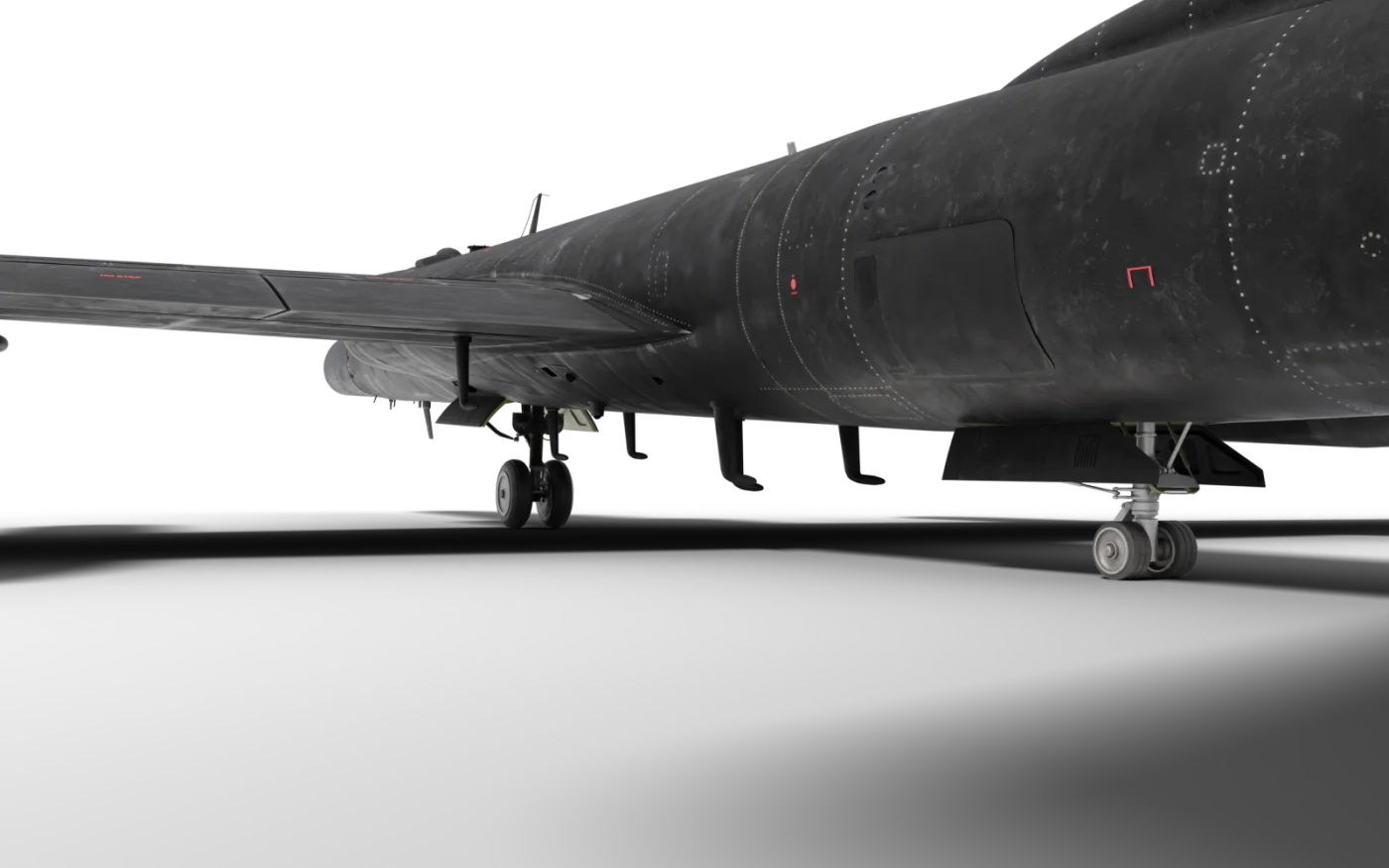
- Main gear (twin wheels)
- Tail gear
- Main gear door
- Speed brake (closed)
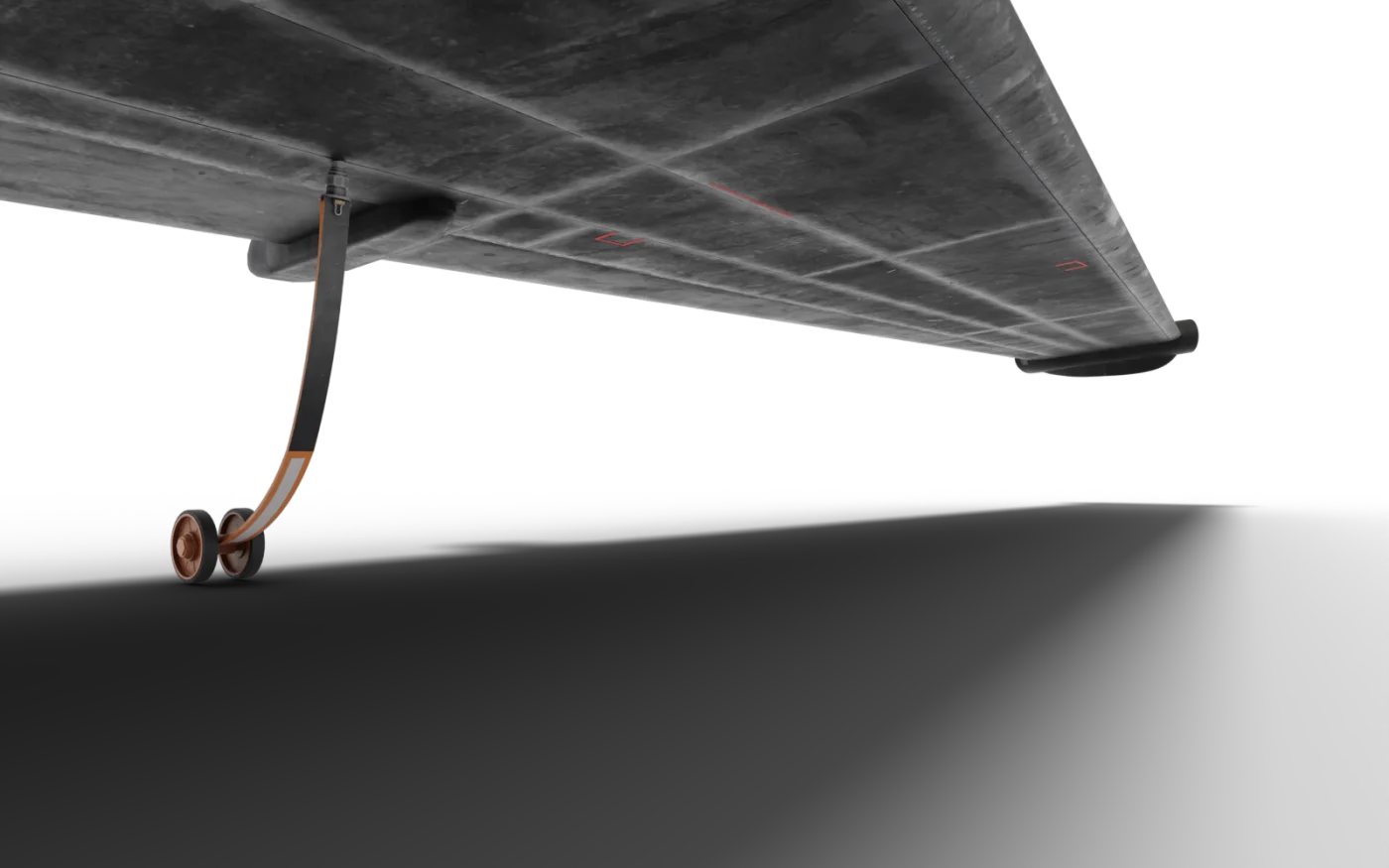
- Pogo wheels
- Pogo leg
- Wingtip skid
Your Mobile (Chase Car)
Real U-2 pilots are talked down by a second pilot in a fast car, the "mobile". Yours appears automatically:
- On departure you hear "mobile's up".
- On final approach (gear down, flaps out, below 1,500 ft) the car joins behind the runway threshold.
- In the flare it calls your height above the runway - "ten... five... two... one" - and "left rudder / right rudder" if you move off the centerline.
There is nothing to switch on, but leave the chase car on: it also brings the runway crew that pulls the pogo pins. See Chase Car and Ground Support Equipment.
Configuration
The sensor nose (ASARS-2 radar, Standard or SYERS-2A camera), the Q-bay camera (OBC), the superpods, the SPAN and the dorsal sensors are selected in the U-2 EFB - see Electronic Flight Bag (EFB). What each one is and does is under Sensors.
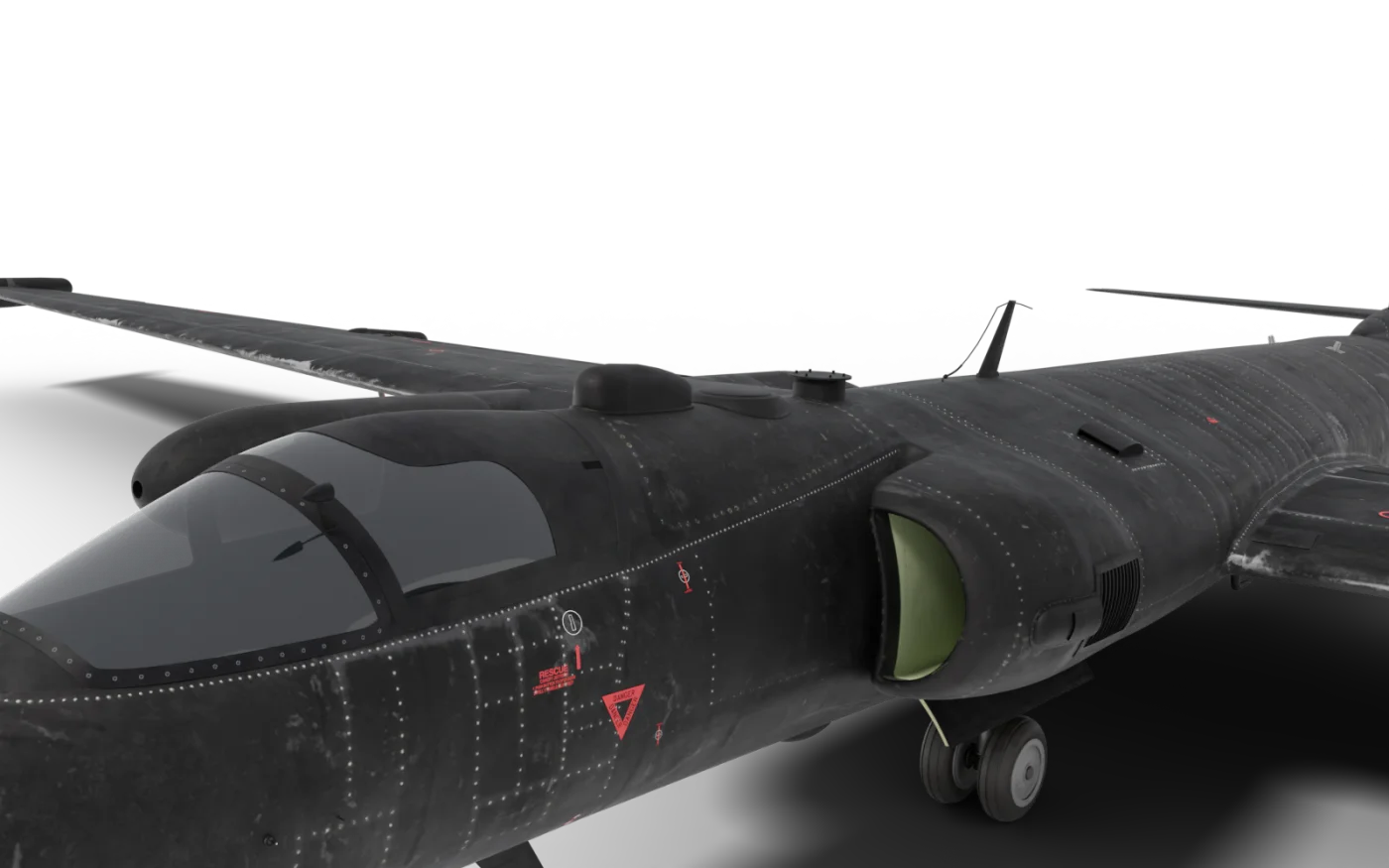
- Forward dorsal sensor
- Middle dorsal sensor
- Aft dorsal sensor
- Canopy