 DOCUMENTATION
Engine Start and Cockpit Controls
The U-2S is started with a pneumatic starting cart, exactly as on the real aircraft: ground crew air spins the Air Turbine Starter, ignition comes on by itself, and the pilot's job is the throttle. This page also covers the other cockpit controls that were added with the engine start: the throttle OFF / IDLE stop, the engine mode switch, the emergency start system, the canopy seal and the seat adjustment.
Sim values. Performance values are measured in the sim. They may not accurately represent (nor do they intend to accurately represent) the performance of the real aircraft.
Throttle OFF / IDLE Stop
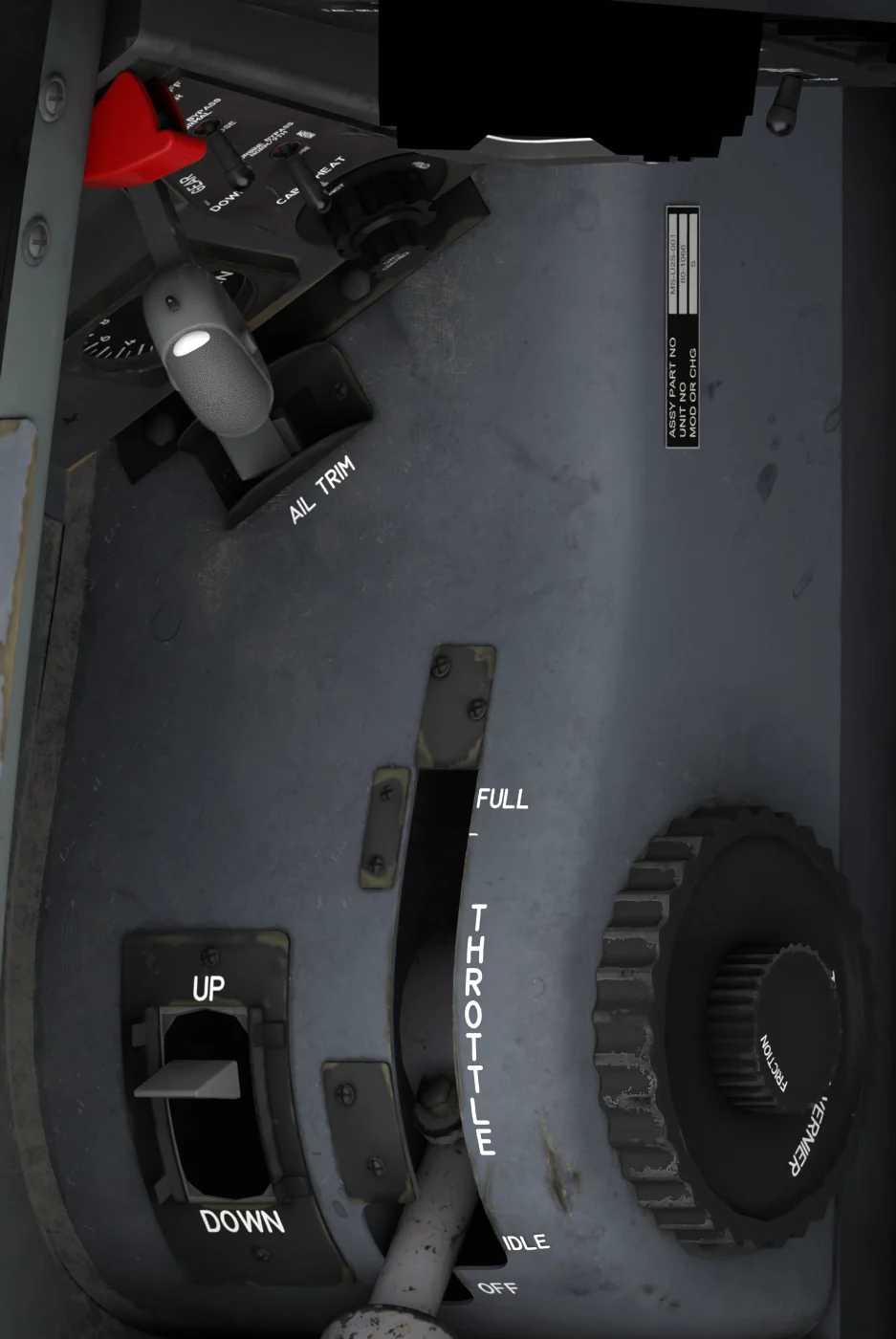
- AIL TRIM - Aileron trim switch: hold left or right. Needs DC power and MANUAL TRIM POWER ON on the yoke. It is slow and small: a second held moves the ailerons about 0.4°, and it ends at about 2°. Small inputs only above 150 KIAS. A roll at speed with the lift spoilers up may be their uneven blow-down: check with them in before you trim it out.
- THROTTLE VERNIER - Outer wheel: turn for fine throttle adjustment, a quarter of a percent per step with the friction at 0, finer as you add friction (0.05 % at 100).
- FLAPS - Spring-loaded switch: left click extends, right click retracts, 5° per click from faired to 35°. With GUST CONTROL UP it stays at OFF and does nothing.
- THROTTLE FRICTION - Inner wheel, 0-100 in steps of 5. More friction gives smaller steps when you wheel or drag the throttle lever and the vernier - at 100 they are a fifth of the normal step. A hardware throttle axis keeps its full range.
- THROTTLE - IDLE to FULL. Below 10 %, right-click moves it between OFF (cutoff) and IDLE. Grip: SPEED BRAKE switch, SPOILER, MIC and AIRSTART buttons. On the ground, parked with the air-start unit on the stand, a press of MIC (here or on the yoke) calls the crew to apply the starting air.
The throttle has a cutoff stop below the idle position. With the throttle below 10 %, right-click the throttle (tooltip THROTTLE IDLE STOP) to move it between OFF and IDLE. Moving the lever forward while in OFF also selects IDLE. From your controller, bind Increase Cowl Flap 4 - see Keybinds Guide.
Your throttle axis covers idle to full power only. The cutoff is a separate click or key, so it cannot be hit by accident.
Ground Start
- Parked off the runway with the PARKING BRAKE set. Battery and ground power on (ground power unit connected on the EFB Ground tab), both FUEL BOOST PUMP switches ON, ENGINE FUEL SHUTOFF ON, ENG MODE in PRI. Bring up SYS → PERF on an MFD.
- Throttle OFF (right-click below 10 %).
- Open the EFB Ground tab, Servicing, Air Supply Unit: Attach, then Apply.Attach brings the air-start unit (out of hiding if need be) to its service point and connects the hose; Apply supplies the air once it is connected. The engine begins to turn; ignition is switched on for you. The air only flows while you stay parked with the brake set - otherwise the selection drops back to Off. A press of MIC on the yoke or throttle selects Apply the same way, as your call to the ground crew; taking the air off again is the EFB's Off, or the crew's once the engine runs.
- At 20 % N2 right-click the throttle to IDLE. Fuel flows, EGT rises and the engine accelerates.Below about 18 % N2 the engine does not light; wait for 20 %.
- At about 50 % N2 the crew removes the air by itself; the hose comes off when you release the parking brake or move. The engine settles at ground idle: about 60 % N2 / 22 % N1 and about 420 °C EGT at a sea-level field.
- Check the lamps: SEC goes out at 54 % N2, AMAD at about 38 %, OIL and HYD as pressures build.If SEC or AMAD comes back on during the start, that repeat does not light the master caution again (on the ground, below 55 % and 48 % N2). The first time still does.
There is no starter switch for the ground start: your starter key is the throttle AIRSTART button and does nothing on the ground. Without starting air applied nothing turns, and the air drives the starter only below 50 % N2.
Engine Mode Switch - PRI / SEC
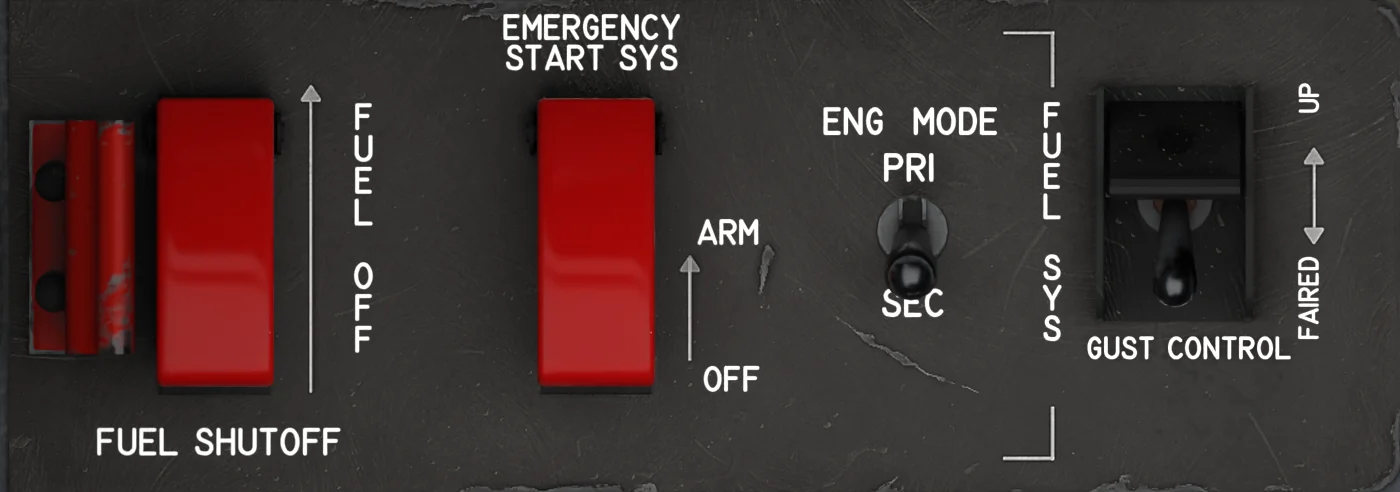
- ENGINE FUEL SHUTOFF (under its guard) - ON (lever aft) / FUEL OFF (lever forward, at the arrow). FUEL OFF closes the engine fuel valve (about 5 s) and stops the engine. Closing the guard returns it to ON; every flight starts with it ON under a closed guard.
- EMERGENCY START SYS (under its guard) - OFF / ARM. Arms the hydrazine airstart, one per flight; the AIRSTART button fires it below 50 % N2. Closing the guard disarms it.
- ENGINE MODE - PRI / SEC. Engine control mode; PRI for flight. SEC lights SEC and takes up to 10 % of the thrust; the throttle still goes to full. SEC then PRI resets an automatic transfer.
- GUST CONTROL - FAIRED / UP. UP unloads the wing in turbulence: flaps 6.25° up and ailerons 7.5° up by themselves, the nose comes up, the flap lever is out of use, red line 241 KIAS.
The ENG MODE switch on the left console selects the engine's primary or secondary control mode. The engine runs in secondary mode during every start (until about 54 % N2, when the engine control has power) and whenever the switch is in SEC: the SEC lamp and ENG MODE SECONDARY show, the thrust is up to 10 % lower at full throttle and nothing limits the EGT.
Leave the switch in PRI for flight: there the engine control holds the EGT at 840 °C. If the engine transfers to secondary by itself (an engine control fault), it stays there until you select SEC and then PRI with the fault gone.
In either mode the MEC cuts the fuel if N2 reaches 110.25 %; bring the throttle below 10 % to clear it.
Airstart - Emergency Start System (ESS)
In flight the normal starter does nothing. If the engine flames out:
- Open the red cover and set EMERGENCY START SYS to ARM. EMER START ARMED appears.
- Below 50 % N2, click the AIRSTART button on the throttle grip, or press your starter key (Toggle Starter 1). A short click is enough. Master CAUTION, the H-70 LEAK lamp and H70 LEAK come on without a tone, and 1 to 4 seconds later (later still when the system has cold-soaked) the hydrazine gas generator drives the starter for about 40 seconds with ignition on.
- Throttle IDLE once N2 is rising.
The engine only lights at 25,000 ft or lower with at least 90 KIAS (at any airspeed below 10,000 ft); between 23,000 and 25,000 ft the light-off comes 5 to 15 seconds late. The system is good for one attempt per flight.
Afterwards the H-70 LEAK lamp and H70 LEAK stay on until the system is serviced: 10 seconds parked with the engine off once the ground crew has refitted the pogos. Close the cover to disarm.
The system only fires with its ground safety pin out. The runway crew pulls that pin just before the pogo pins, and after a landing puts it back with the pogos: with the pogos still on (or no runway crew) there is no airstart.
Air starts come with it out. With the pin out, ARM and AIRSTART fire the system on the ground too. The EFB Ground tab's Emergency start system card shows the pin, the nitrogen bottle pressure (read on the ground) and whether the hydrazine is serviced or used.
Seat Adjustment
The SEAT ADJ switch on the lights and spoiler panel (left side wall) moves your eye point. Hold the left mouse button for UP, the right button for DOWN; the switch springs back to OFF when released. It needs DC power.
Fuel Shutoff
The ENGINE FUEL SHUTOFF switch is under a red guard. Open the guard and select FUEL OFF to shut the engine down; the valve takes about 5 seconds to close and needs emergency DC power. Closing the guard returns the switch to ON.
Power and EGT
The engine runs on corrected speed, so N1, N2 and EGT at a given lever position change with altitude. EGT follows engine speed and the outside air temperature: the SYS → PERF gauge, the standby dial and EGT HIGH all use the same figure. Climb power is full throttle, then the vernier back to hold the EGT.
| Condition | N1 | N2 | EGT |
|---|---|---|---|
| Ground idle, sea level | about 22 % | about 60 % | about 420 °C |
| Full throttle, takeoff | about 94 % | about 101 % | about 760 °C |
| Climb power, 45,000 - 66,000 ft | 93 - 95 % | 98 - 99 % | 650 - 725 °C |
| Full throttle above about 55,000 ft | about 96 % | 99 - 101 % | about 830 °C at 55,000 ft, then held at 840 °C by the engine control in PRI (no limit in SEC) |
| Idle, descending above about 18,000 ft (flight idle) | 65 - 75 % | 80 - 85 % | about 400 - 500 °C |
Standard day. A day 20 °C above standard shows about 830 °C at full throttle on takeoff.
High up the EGT sits near 650 °C over a wide band of N2, from about 94 % to about 98.5 %, then climbs quickly: about 690 °C at 99 %, about 780 °C at 100 %. Move the vernier in small steps.
Flight idle comes down above 50,000 ft, to about 69 % N1 and 81 % N2 at 70,000 ft, so the aircraft can slow down up there.
Standby Engine Gauges
Three round gauges below the right MFD show N2 (% rpm), EGT (°C) and fuel flow (gallons per hour × 100). They read straight from the engine and keep working when the MFDs are dark.
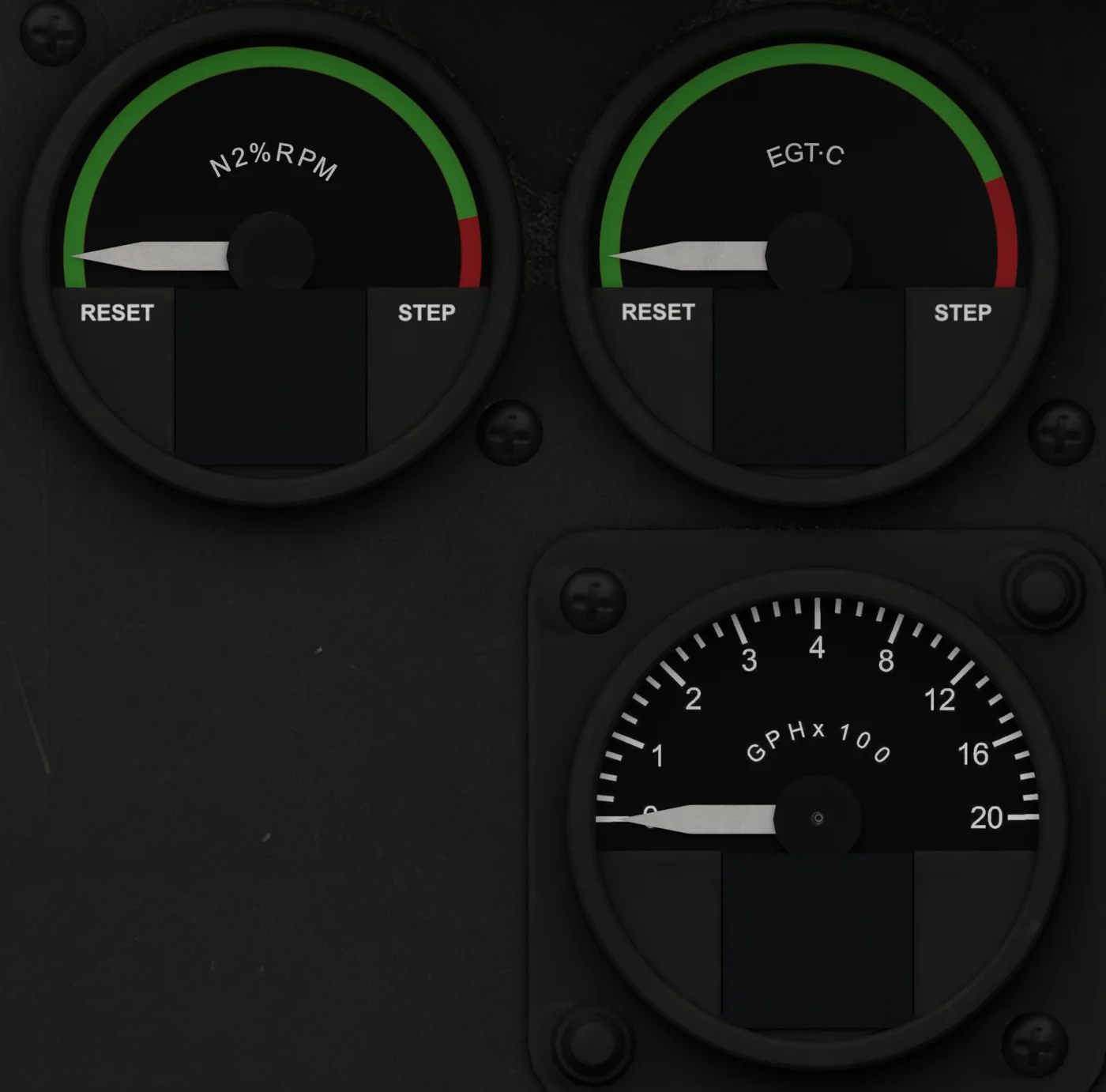
- N2 - Standby N2 in % rpm, read straight from the engine; keeps working with the MFDs dark. About 60 % at ground idle.
- EGT - Standby exhaust gas temperature in °C, read straight from the engine, independent of the MFDs.
- FUEL FLOW - Standby fuel flow in gallons per hour x 100, read straight from the engine, independent of the MFDs. Its window is the fuel totalizer: the fuel remaining in gallons, counted down from the fuel flow - the same count as SYS/PERF TOTAL, set with LOAD or 500 there.